Research studies already suggest that AI can perform as well as or better than humans at key healthcare tasks, including disease diagnosis.
SepSeek Comprehensive Panel
A development-stage software platform designed to bring machine-learning risk signals into hospital workflows, beginning with patients at risk of developing sepsis.
Initial clinical focus
Sepsis risk and readmission prediction
Patient risk overview
Model signal
Sepsis riskElevated
78
VitalsBlood testsClinical observations
Help care teams recognize risk before deterioration becomes obvious.
Artificial intelligence and related technologies are increasingly prevalent in business and society and are beginning to be applied to healthcare. These technologies can potentially transform many aspects of patient care and administrative processes within providers, payers, and pharmaceutical organizations.
Healthcare systems generate a continuous stream of vitals, laboratory results, observations, and patient history. The challenge is turning those signals into clear, timely context without adding more noise to a clinician's workflow.
Delphine Diagnostics is in the process of developing a machine-learning-based healthcare software platform and multiple software applications based on the AI/ML healthcare platform. The first set of products addresses the need for improving patient outcomes for patients at risk of developing sepsis in the hospital setting.
A collection of technologies, applied to specific clinical tasks.
AI is not one technology, but a family of analytical methods. Machine learning is one of the most common forms, using data to train statistical models that learn patterns relevant to defined tasks.
Algorithms are already outperforming radiologists at spotting malignant tumors and helping researchers construct cohorts for costly clinical trials.
Most AI technologies have immediate relevance to healthcare, but the processes and tasks they support vary widely across clinical and operational workflows.
One platform, a growing set of clinical questions.
The product roadmap begins with in-hospital and discharge-stage risk prediction, then expands toward treatment support informed by clinical and molecular diagnostic data.
Identify patients at risk of developing sepsis.
Use a set of clinical features, including vital signs and blood-test results, to predict whether a patient is at risk of developing sepsis in the hospital setting.
Estimate sepsis-related readmission risk.
Apply the same product just before discharge to help predict whether a patient is at risk of readmission due to sepsis.
Support treatment decisions.
The next phase is intended to assist clinicians with treatment for patients who already have sepsis, using pathogen-identification findings from Delphine's Sepsis Diagnostics kit.
Different models, combined for a more useful signal.
This product makes use of an ensemble of machine-learning models, bringing together established statistical methods and machine-learning architectures.
Logistic Regression
Interpretable statistical modeling for estimating clinical risk.
Random Forest
Tree-based learning for nonlinear relationships and feature interactions.
Neural Networks
Flexible learning architectures for patterns across complex clinical data.
Combined outputPatient-level risk context
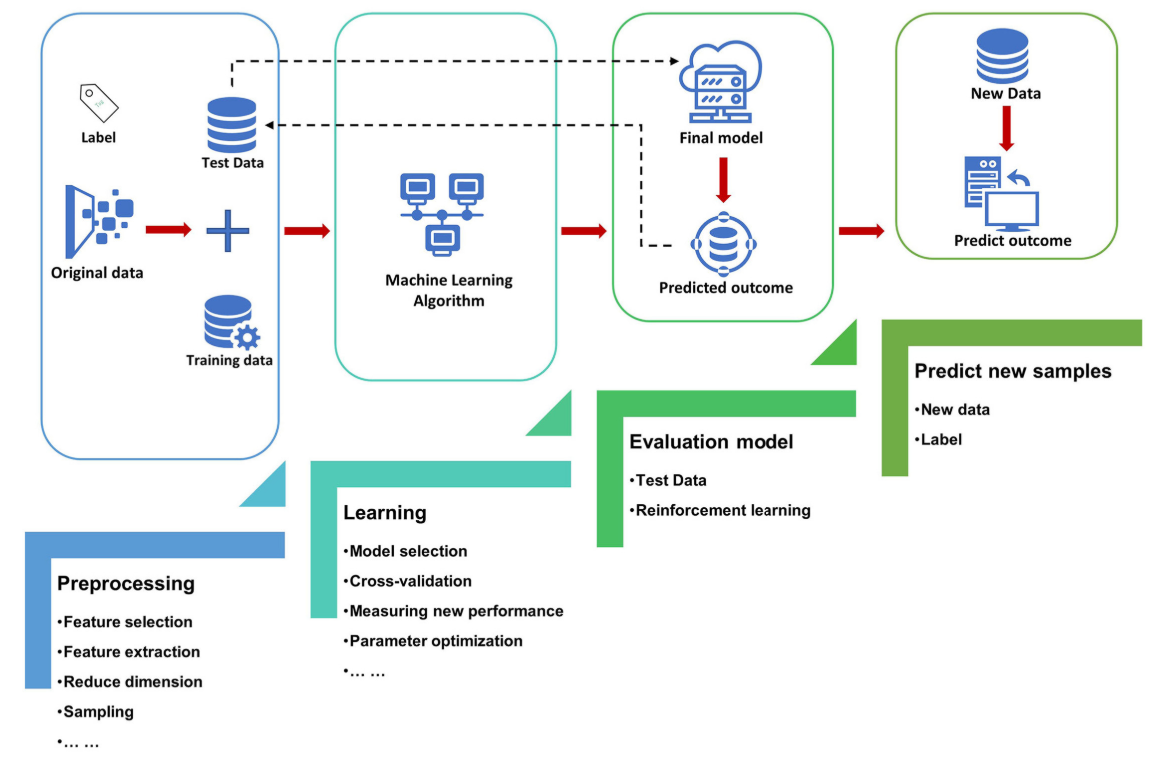
Development is more than training a model.
The referenced roadmap illustrates a continuous process spanning problem definition, data preparation, model development, evaluation, deployment, and monitoring.
Meet clinicians inside the hospital workflow.
Both the sepsis-risk and treatment-support products are planned to integrate with the electronic medical record systems of the hospitals where Delphine's AI/ML model solution is used.
- 01Clinical data
Vitals, blood-test results, observations, and relevant patient context.
- 02Model ensemble
Multiple analytical approaches evaluate patterns associated with risk.
- 03Workflow context
Risk information is intended to connect with the hospital EMR environment.
- 04Future diagnostic insight
Planned treatment support may incorporate pathogens, fungi, viruses, and bacteria identification results from Delphine's Sepsis Diagnostics kit.
Build useful intelligence around real care environments.
Delphine welcomes conversations with hospitals, clinical teams, data partners, and healthcare technology organizations interested in sepsis prediction and workflow integration.
Development-stage software
The Delphine AI/ML Healthcare Platform is described as being under development and is not presented here as commercially available, clinically validated, or cleared for clinical use.